Every startup founder hits the same wall eventually: a marketing budget that's a fraction of what feels necessary, and a list of things "everyone says you need" — a website, social media, SEO, ads, branding, email marketing, maybe a CRM — that would cost several times what's actually available.
The instinct is usually to spread the budget thin across everything at once, doing a little bit of each. That's almost always the wrong move. A little bit of everything usually means not enough of anything to actually work. The startups that get real traction with limited budgets aren't the ones doing more, they're the ones sequencing correctly.
Why Order Matters More Than Budget Size
Marketing channels aren't equally valuable at every stage. Running ads before you have a website that converts is wasted. Posting on social media before you have a clear offer confuses more than it attracts. Every dollar spent out of order is a dollar spent with reduced effectiveness — which is exactly why budget-constrained startups can't afford to get the order wrong.
Here's the sequence that actually protects a limited budget.
Priority 1: A Website That Actually Converts
Before anything else gets funded, the website needs to work. Every other marketing effort — ads, social posts, referrals, press — eventually sends someone here. If it doesn't clearly explain what you do and make it easy to take the next step, everything upstream of it underperforms, no matter how much gets spent driving traffic to it.
This doesn't need to be elaborate. A focused site with a clear value proposition, one obvious call to action, and mobile-friendly design will outperform a beautiful ten-page site that confuses visitors about what to do next.
Priority 2: A System for Capturing and Following Up on Leads
This is the step most startups skip — and it's often the most costly gap. Every early lead matters disproportionately when volume is low, yet without a system to capture and follow up automatically, leads get missed simply because there's no dedicated team to chase them down.
This is where a lightweight CRM or automation tool earns its cost fast: it makes sure a lead that comes in at 10 PM, or during a week the founder is buried in product work, still gets a response instead of going cold. At this stage, losing even a handful of leads to slow follow-up is a measurable percentage of the total pipeline.
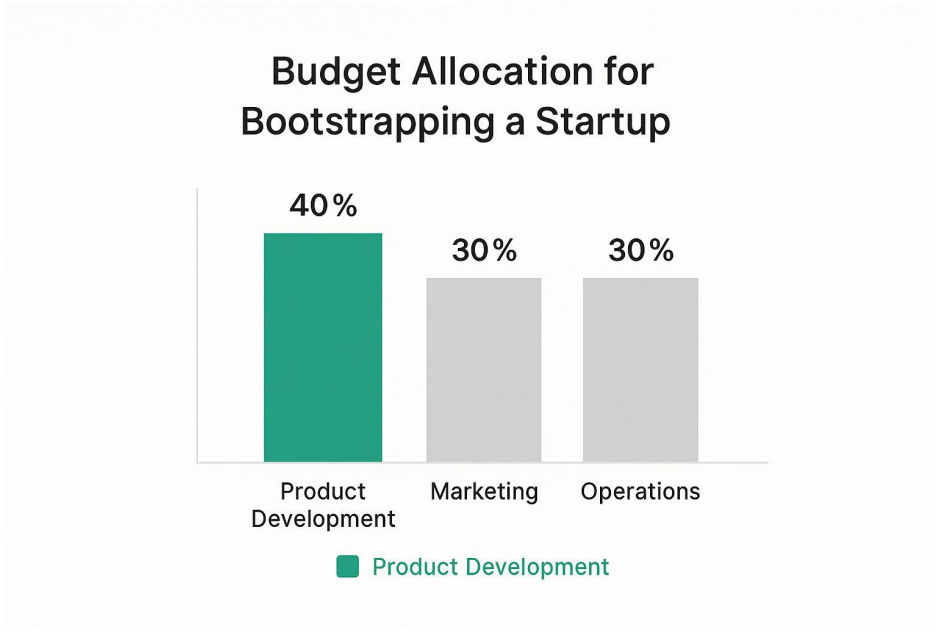 Startup Budget Strategy
Priority 3: One Marketing Channel, Done Well
Startups often try to be everywhere — Instagram, LinkedIn, TikTok, email, ads — at a level of effort that's too thin to work on any of them. A better use of a limited budget is picking the one channel where your actual customers spend time, and doing it consistently well, rather than doing five channels poorly.
For most local and B2B startups, this tends to be either targeted paid ads (fast, immediate visibility) or consistent organic social/content (slower, but compounding). Choosing based on how quickly you need results and how much runway you have to wait for compounding growth matters more than trying to cover every option.
Priority 4: SEO - A Long-Term Investment, Started Early
SEO doesn't produce fast results, which is exactly why it gets deprioritized by budget-constrained startups — and exactly why starting it early is valuable. The startups still visible in search two years from now are usually the ones who began investing while it felt "too early." This doesn't need a large budget on day one; it needs to start.
Priority 5: Paid Ads, Once the Foundation Can Actually Convert
Ads amplify whatever they point to. Pointed at a weak website or a business without a lead-capture system, ad spend mostly just teaches you that ads "don't work" — when really, the foundation wasn't ready to convert the traffic. Once the first three priorities are solid, ad spend becomes far more efficient, because the traffic it drives actually has somewhere effective to land.
What This Looks Like on a Real Budget
A useful way to think about a limited startup marketing budget isn't "how do I fund everything a little," but "how quickly can I fund the first priority well enough to build on top of it."
A workable path often looks like:
- Get the website and basic lead capture right first — even if it delays other spending.
- Add lightweight automation as soon as leads start coming in, so nothing gets lost.
- Pick one channel and commit real, consistent effort to it.
- Layer in SEO in parallel — it's cheap to start early and expensive to start late.
- Only add paid ads once there's a foundation that can actually convert that traffic.
Skipping steps to "do everything" usually costs more in wasted spend than it saves in time.
How This Fits With Zaptal
This is essentially how we advise startups we work with: building the foundation (website, lead capture, automation) before scaling spend on visibility. As a full digital agency, Zaptal can build that foundation and layer in AI automation, social media management, SEO, and paid campaigns as the budget allows, in the order that actually protects it, rather than pushing every service at once regardless of where a business actually is.
FAQs
Should a startup skip social media entirely if the budget is tight?
Not necessarily skip it — but avoid spreading effort across every platform. Picking one platform where your actual customers spend time and being consistent there works better than a thin presence everywhere.
Is it ever too early to start SEO?
No, SEO is one of the few marketing investments where starting early costs little and pays off disproportionately later, since rankings build over time rather than instantly.
What's the most common budget mistake startups make?
Funding paid ads before the website and lead-capture system are ready to convert that traffic, which wastes spend on visibility the business isn't yet equipped to turn into customers.
How much should go toward automation on a tight budget?
Even a small allocation toward automated lead follow-up tends to pay for itself quickly at early stages, since every lead matters more when overall volume is low.
Written by
Tayyaba Ahmed